10 Best Laptop Cooling Pads of 2026, Quiet, Gaming and Large-Laptop Picks Ranked
Laptops run hot, and a warm one on your knees on the sofa makes that obvious fast. A cooling pad won't fix a clogged heatsink, but it can push more air underneath and lift the screen to a better height. After weeks with UK roundups, spec sheets and amazon.co.uk listings, the best laptop cooling pad for most people is the Targus Dual Fan Lap Chill Mat, a neoprene lap mat with USB-powered fans that works on a desk too.
I didn't test these hands-on. The list runs from quiet lap mats and mesh stands to sealed turbofan pads for gaming laptops. Some have editorial backing; the rest are judged on their listings, and I say which.

- Strong cooling airflow: Dual fans disperse heat from underneath. Keeps warm air off your knees.
- Wide laptop fit: Fits laptops with screens up to about 40 cm. Covers most models.
- Useful desk extras: Neoprene base shields your lap and desk from laptop heat.
- Sturdy, stable build: Neoprene base with a mesh top. Soft on knees, firm underneath.
- Simple USB power: Runs off a single USB-A port. No wall socket needed at all.
- Easy to carry: Slim 2.5 cm profile and soft base. Slides into a bag easily.
- Muddled fan spec: Title says dual fan, but the listing also mentions single-fan dispersal.
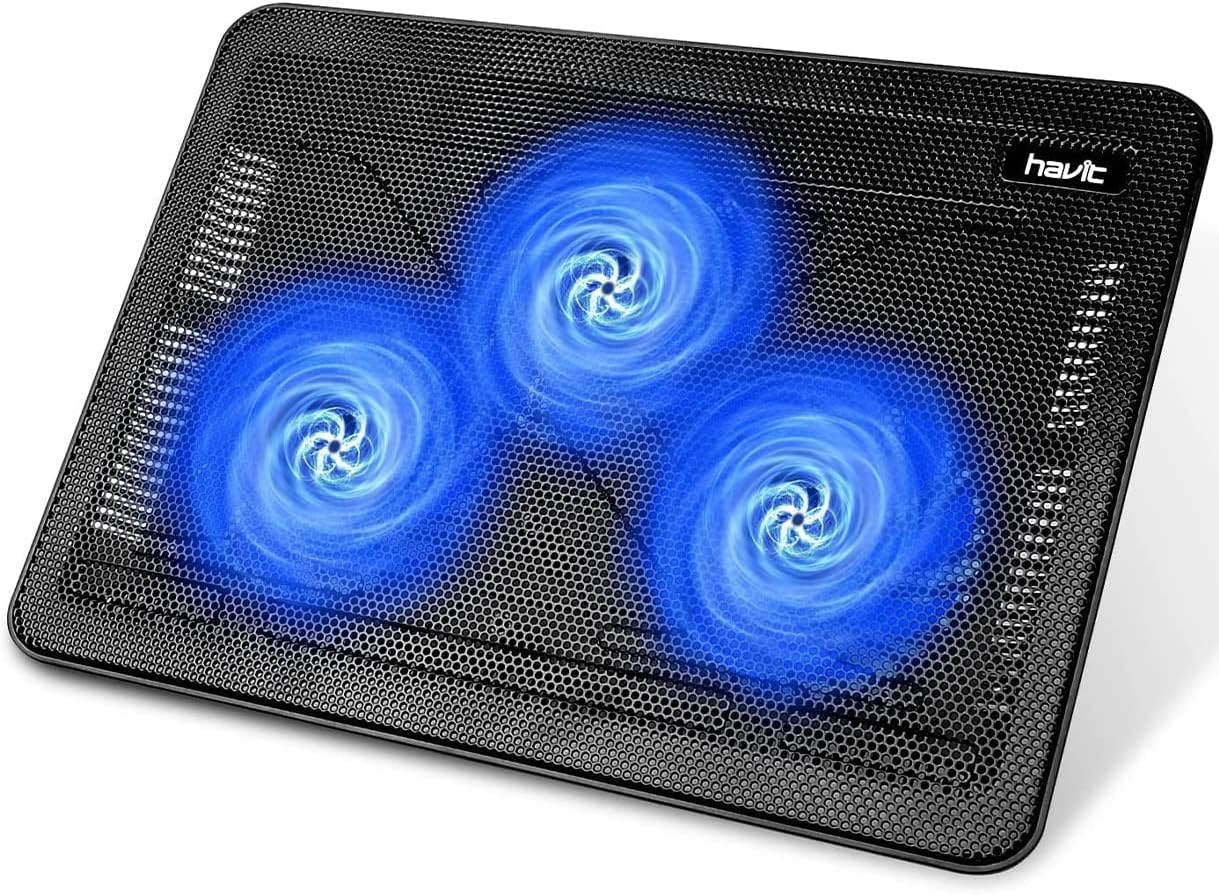
- Strong cooling airflow: Three 110mm fans at about 1100rpm. Broad airflow under the base.
- Wide laptop fit: Built for larger laptops. A big 38 x 28 cm mesh top.
- Useful desk extras: Extra USB port and a power switch. Handy for a wired mouse.
- Sturdy, stable build: Metal mesh gives a stable surface. Two height settings for typing.
- Simple USB power: Powered by the supplied USB cable. Plugs straight into the laptop.
- Easy to carry: Slim and light design. Easy to slip into a laptop bag.
- USB-C adapter: The supplied cable is USB-A, so USB-C-only laptops need an adapter.

- Strong cooling airflow: Three quiet fans up to 1400 rpm. Blue LEDs show they're running.
- Wide laptop fit: Fits compact ultrabooks through to large laptops. MacBook, Lenovo and Asus listed.
- Useful desk extras: Two USB ports. One powers the pad, the other runs a mouse.
- Sturdy, stable build: Plastic frame with a large metal mesh. Light but durable build.
- Simple USB power: USB powered with a pass-through port. You don't lose a socket.
- Two angles only: Just two tilt angles, far fewer than the Liangstar's seven settings.

- Strong cooling airflow: Four quiet fans spinning up to 1200 rpm. An even spread of air.
- Wide laptop fit: Small and mid-size laptops sit fully on it. Larger ones overhang slightly.
- Useful desk extras: Two USB ports leave one free. Suits a mouse or a keyboard.
- Sturdy, stable build: Front pegs stop the laptop sliding. Rear legs set the incline.
- Simple USB power: Takes power from a single USB port. Nothing else to plug in.
- Big-laptop overhang: The largest laptops hang over the edges of the pad.

- Strong cooling airflow: Six quiet fans at up to 2100 rpm. Run three or all six.
- Wide laptop fit: Fits compact to large laptops. Dell, MacBook Pro and ThinkPad named.
- Useful desk extras: Pop-out phone holder on the left side. Two USB ports as well.
- Sturdy, stable build: Metal mesh with a non-slip baffle. Stops laptops sliding off.
- Simple USB power: USB powered, with a spare port. Two switches set the fan speed.
- Bulky when raised: Fully raised it stands 16.8 cm tall, so it's no slim travel pad.
- Blue colourway: This link is the blue version, so check other colours separately.

- Strong cooling airflow: One large 200mm fan at 700rpm. Moves air without much noise.
- Wide laptop fit: Suits small and mid-size laptops. A good match for slim work machines.
- Useful desk extras: Built-in two-port USB hub. Keeps a mouse plugged in nearby.
- Sturdy, stable build: Front anti-slip holder. Keeps the laptop from sliding off the slope.
- Simple USB power: A single USB connection powers it. No adapter or wall socket.
- Size limit: It tops out at mid-size laptops, so large gaming machines won't fit.

- Strong cooling airflow: Turbo fan up to 2800 RPM. Foam seal focuses air into vents.
- Wide laptop fit: Made for mid-size and large gaming laptops. Asus ROG and Alienware listed.
- Useful desk extras: Three USB 3.0 ports and RGB lighting. A removable dust filter too.
- Sturdy, stable build: Aluminium body with a foam seal. Holds the air under the laptop.
- Windows-only software: Control software runs on 64-bit Windows only, with no macOS or Linux.
- Desk-bound bulk: A hefty sealed turbofan pad. Not one to carry in a laptop bag.
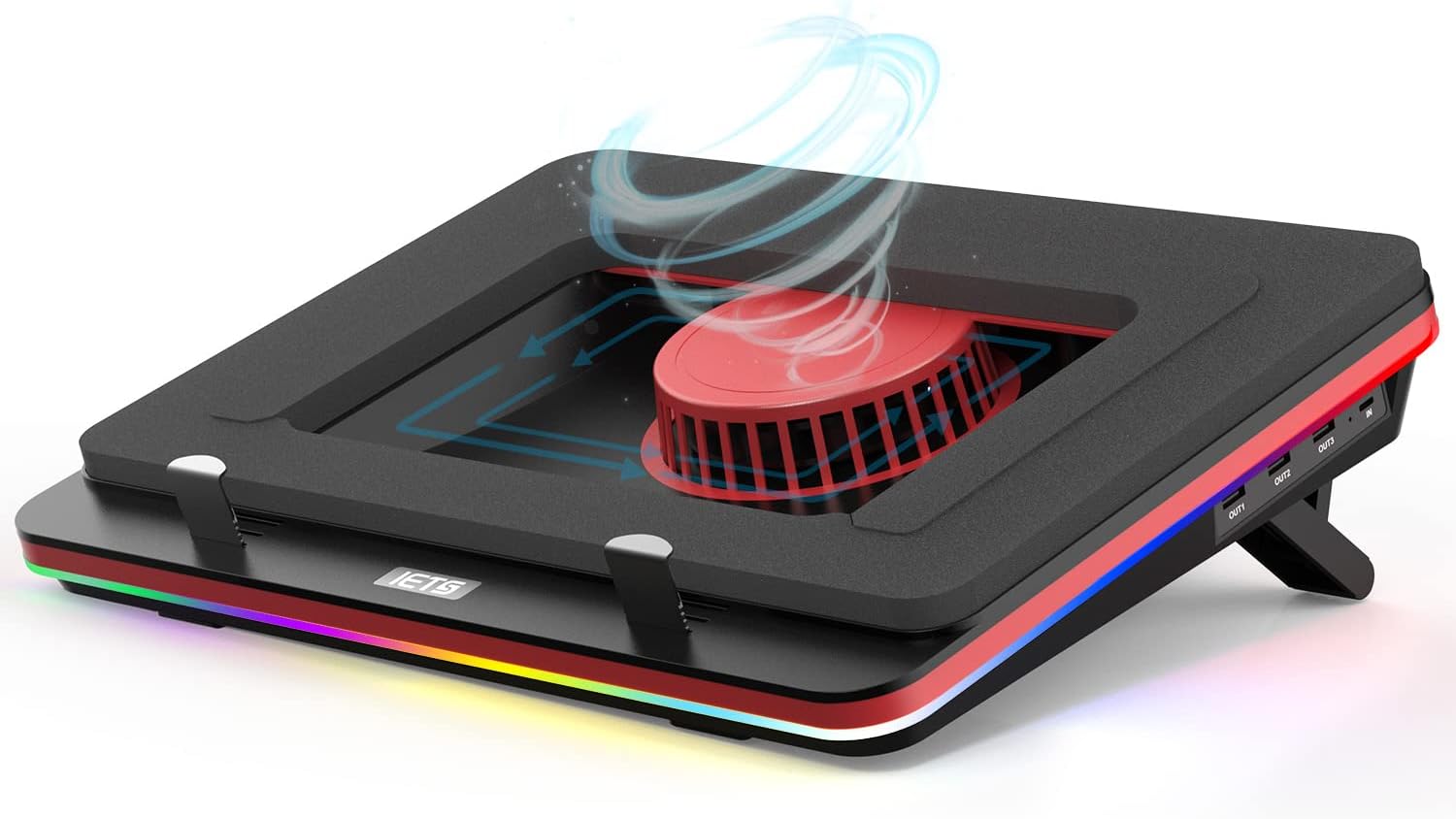
- Strong cooling airflow: Turbofan up to 5000 RPM. Infinitely variable speed from zero upward.
- Wide laptop fit: Seal foam adapts to different laptop sizes. Suits rear-exhaust gaming laptops.
- Useful desk extras: Three-port USB hub plus RGB lighting. The lights can be switched off.
- Sturdy, stable build: Metal body at 1.65 kg. Stays planted on a desk while gaming.
- Fan noise: IETS itself warns noise-sensitive users to choose this one carefully.
- Weight: At 1.65 kg, it's a desk fixture rather than a bag pad.
- Foam fiddling: The seal foam needs arranging around your laptop for best results.

- Strong cooling airflow: Five blue-lit fans, one 130mm and four 50mm. Air across the base.
- Wide laptop fit: Takes large gaming laptops. An aluminium mesh plate supports the base.
- Useful desk extras: Detachable phone stand in the box. Keeps your phone in sight.
- Sturdy, stable build: Aluminium mesh top plate. Tilts in five steps up to 190mm high.
- Simple USB power: One USB power cable, included in the box. Simple desk setup.
- Blue-only lighting: Blue-lit fans only, with no RGB modes like the TopMate C12.
- Unlisted fan speed: No fan speed figure or speed control is given on the listing.

- Strong cooling airflow: Six fans, three large and three small. Three fan modes to pick.
- Wide laptop fit: Covers small laptops through to large gaming models. Wide size range.
- Useful desk extras: Hideable phone holder and two USB ports. A braided cable too.
- Sturdy, stable build: Oversized base spreads the weight. Steady on a desk or lap.
- Simple USB power: USB powered via a reinforced braided cable. No mains plug needed.
- Bright RGB strips: Light strips run along all sides, which some will find distracting.
- Unproven model: An older TopMate pad got roundup coverage, not this C12.
Other Laptop Cooling Pads Worth Considering

- Five fans: one small and four large.
- Five height settings and a phone stand.
- Adjustable fan speed via a switch wheel.
- Only suits small and mid-size laptops.
- No editorial coverage turned up for it.

- Two 9cm fans and a 12cm centre fan.
- Height adjusts from 13cm to 23cm.
- Comes with both USB-C and USB cables.
- Listing data disagrees on the fan count.
- No reviewer coverage in our research.

- Nine fans with six speed settings.
- Nine heights and 10 RGB modes.
- Small LCD display and two USB 2.0 ports.
- RGB lighting may not suit an office.
- Thin listing with no editorial coverage.
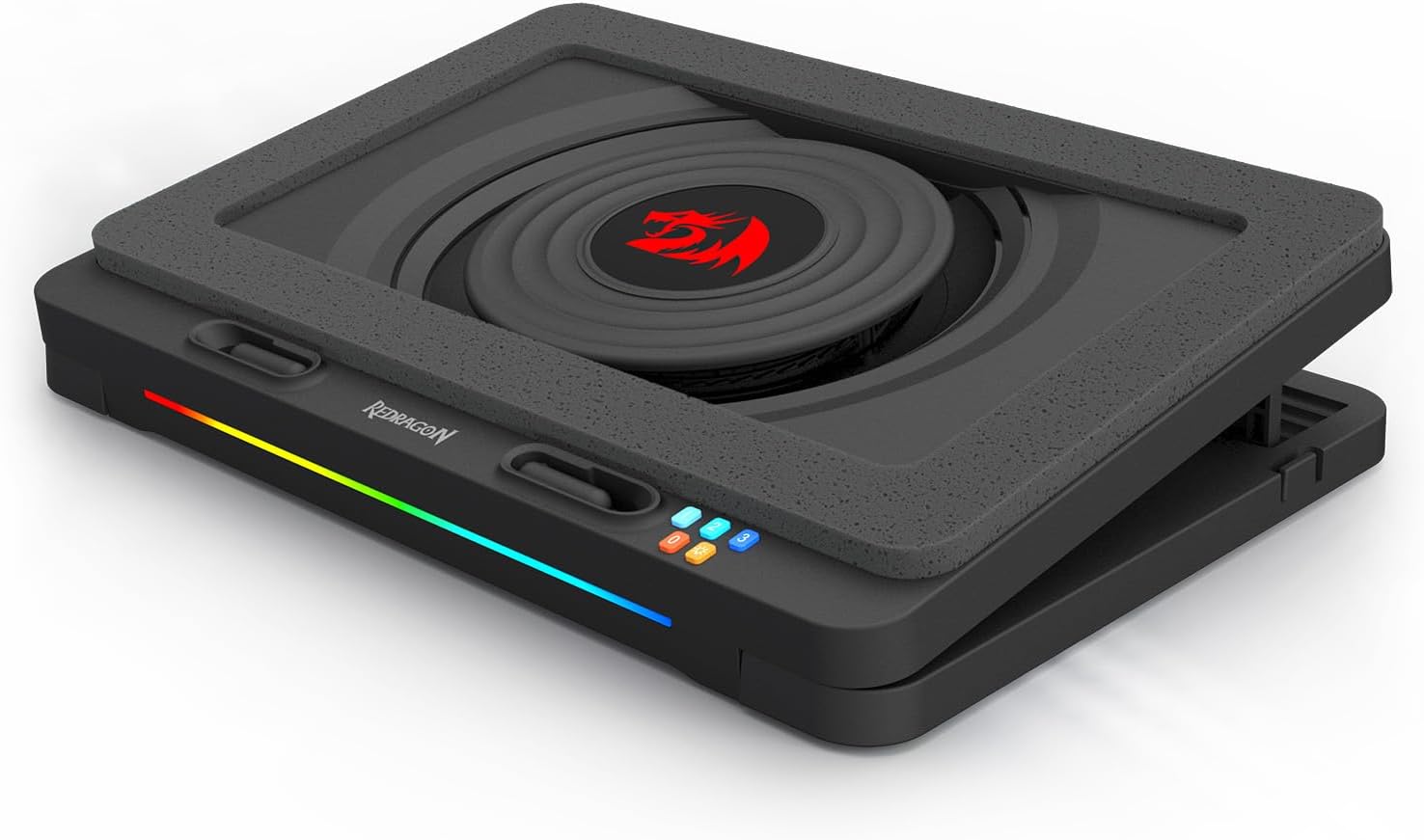
- Large 150mm fan with a sealed sponge.
- Three fan speeds and four heights.
- Phone holder and RGB lighting.
- Rated at 52-58 dB, so it isn't silent.
- Built for larger laptops only.
In-Depth Reviews of Our 10 Laptop Cooling Pad Picks
Who each pad suits, what the listing actually promises, and where it falls short.
#1 · Editor's Choice
Targus Dual Fan Lap Chill Mat Laptop Cooling Pad
As a do-everything pad, the Lap Chill Mat is my pick, mainly because it works where people actually overheat laptops: on the sofa. My work laptop spends most evenings on my knees in the living room, and a soft neoprene mat with a mesh top and USB-A powered fans suits that better than a rigid stand. It takes laptops with screens up to about 40 cm. Targus's Lap Chill Mat turns up in several UK roundups, once as the top pick. The title says dual fan, but the same listing mentions single-fan heat dispersion, and there's no fan speed or height adjustment listed. On a desk, the Havit HV-F2056 gives you more fans and two heights.
The verdict: The pad I'd buy for sofa and desk use, as long as you don't need height adjustment.
#2 · Runner-Up
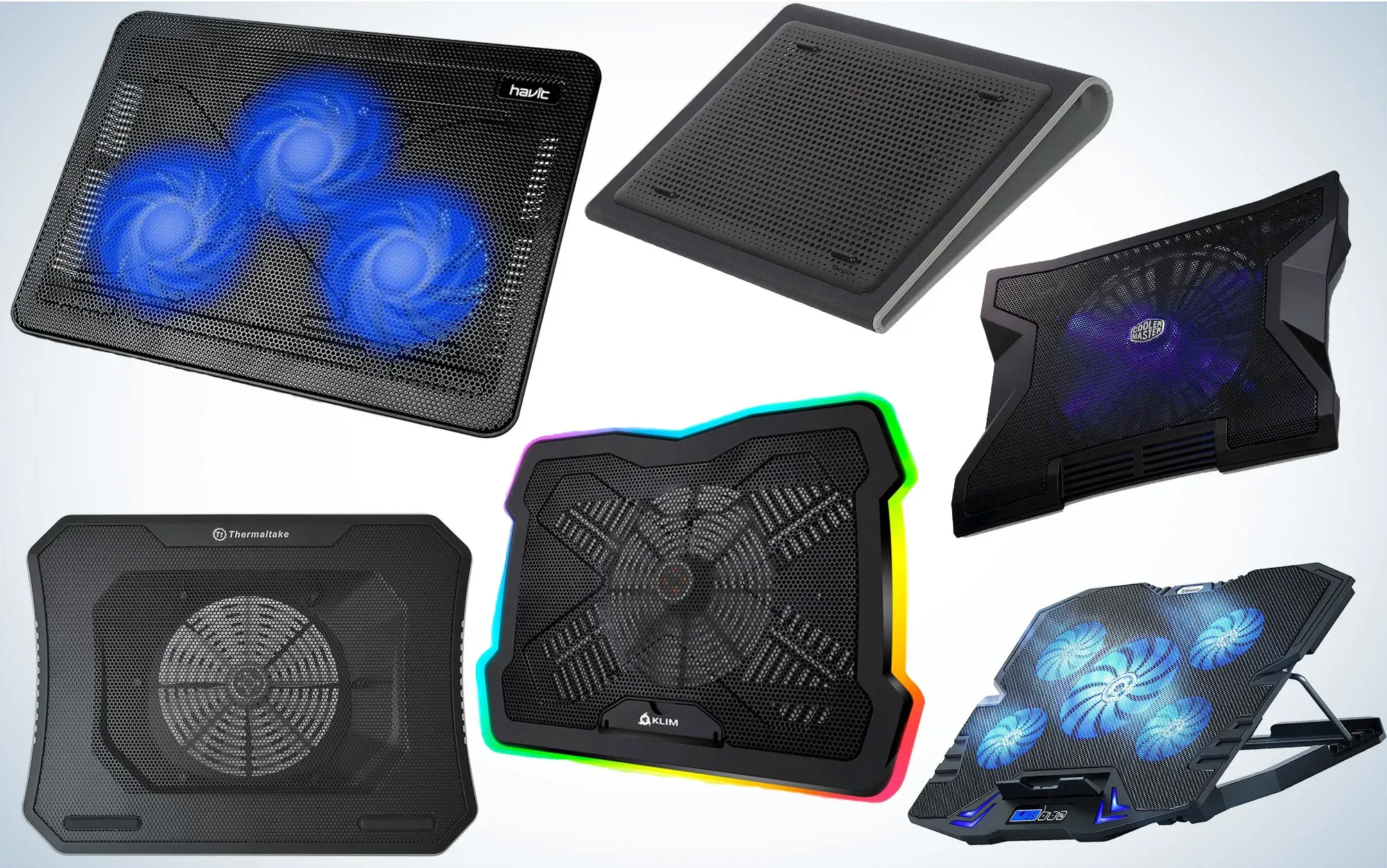
Havit HV-F2056 Laptop Cooling Pad with 3 Fans
Three 110mm fans, a metal mesh top and two height settings make the HV-F2056 the most sensible desk pad I found for larger laptops. Havit quotes about 1100rpm, and there's a power switch plus an extra USB port, so you don't lose a socket for your mouse. One UK roundup puts it first on its list. The supplied cable is USB to USB, though, so a USB-C-only laptop needs an adapter, which is a small faff for MacBook owners.
The verdict: An affordable, no-fuss desk pad for larger laptops.
#3 · Best Budget
Tecknet N8 Laptop Cooling Pad with 3 Quiet Fans
If you're after a cheap laptop cooling pad that fits almost anything, start here. Tecknet says the N8 takes everything from compact ultrabooks to large laptops, with MacBook, Lenovo and Asus models named, and its three quiet fans run at up to 1400 rotations per minute. Two USB ports mean one powers the pad while the other runs a mouse or keyboard. There are only two tilt angles, though, against seven on the Liangstar. Tecknet pads appear in two UK roundups, but not necessarily this exact N8. The link is the white version.
The verdict: The entry-level pick that fits the widest range of laptops.
#4 · Best Four-Fan Pad
Klim Wind Laptop Cooling Pad with 4 Fans
Four fans is the Klim Wind's whole pitch. They spin at up to 1200 rpm, and the pad adds two USB ports, rear legs for an adjustable incline and front pegs that stop the laptop sliding off. Small and mid-size laptops sit fully on it; Klim says bigger machines are compatible but will extend over the edges, which I'd rather avoid on a gaming laptop with intakes near the rim. One UK roundup includes the Wind. The link is the blue version.
The verdict: A solid four-fan desk pad for small and mid-size laptops.
#5 · Best for Large Laptops
Liangstar Laptop Cooling Pad with 6 Fans and Phone Holder
Got a big laptop and a sore neck? The Liangstar is the stand I'd look at. It has six quiet fans at up to 2100 rpm, with two switches so you can run three or all six, and seven height settings. A pop-out phone holder sits on the left, and two USB ports keep one free. One UK roundup names it its pick for large laptops. The downside of all that height is bulk: fully raised it stands 16.8 cm tall, so it's a desk fixture rather than a bag pad.
The verdict: The adjustable big-laptop stand to beat at the entry level.
#6 · Best for Quiet Rooms
Cooler Master NotePal CMC3 Laptop Cooling Pad
Quiet is the point here. The NotePal CMC3 uses one large 200mm fan at 700rpm, and Cooler Master quotes about 21 dBA, the only noise figure among my top ten. A front anti-slip holder keeps the laptop on the slope, and there's a two-port USB hub. The trade-off is size: it tops out at mid-size laptops, so large gaming machines are out. No editorial coverage turned up, so it ranks on its spec sheet. For a spare-room desk where a whiny fan would grate on video calls, this is the one I'd try first.
The verdict: The quiet choice for smaller work laptops.
#7 · Best for Gaming
Llano V12 Ultra RGB Laptop Cooling Pad
Look, this is a gaming tool. The V12 Ultra uses a turbo fan that llano rates at up to 2800 RPM, with a foam seal that forces air up into the laptop rather than letting it spill out of the sides. It's made for mid-size and large gaming laptops (llano lists the Asus ROG Strix G16 and Alienware M18), and adds three USB 3.0 ports, a removable dust filter and RGB lighting. The control software is Windows 64-bit only, so MacBook owners lose those features. No editorial coverage turned up. Against the IETS GT500, it trades top fan speed for software control.
The verdict: The gaming pad for Windows players who want software control.
#8 · Best Turbo Blower
Iets GT500 Turbofan RGB Laptop Cooling Pad with USB Hub
Here's a blunt one: IETS tells noise-sensitive buyers to choose carefully, and I'd take that warning seriously. The GT500 is a turbofan pad rated up to 5000 RPM with infinitely variable speed, plus seal foam you arrange to suit your laptop so air goes into the vents rather than out of the sides. Its bottom air intake is aimed at gaming laptops that exhaust from the rear. At 1.65 kg, it stays on the desk. An older IETS model appears in one UK roundup; this one ranks on its listing.
The verdict: Raw airflow for gaming laptops, if you can live with the noise.
#9 · Best Budget Gaming
Trust GXT 1125 Quno Laptop Cooling Stand
Trust's Quno is the budget route into a proper gaming stand. It has five blue-lit fans (one 130mm and four 50mm) under an aluminium mesh plate, and it tilts in five steps up to 190mm high. A detachable phone stand and a USB power cable come in the box. Two UK roundups include it. There's no fan speed listed, though, and the lighting is blue only, so it lacks the TopMate C12's RGB modes.
The verdict: A sturdy, tall gaming stand at a mid-range level.
#10 · Best RGB Lighting
TopMate C12 RGB Laptop Cooling Pad with 6 Fans
RGB first, everything else second. The C12 wraps light strips round all four sides with 10 lighting modes, and runs six fans (three large, three small) in three modes. It adjusts to eight heights, hides a phone holder, and its oversized base is meant to sit steadily on a desk or your lap. An older TopMate pad got roundup coverage, not this one, and the link is the Ice Blue version. If the lights would bother you, the Klim Wind does the basics with less fuss.
The verdict: For gamers who want the light show as much as the airflow.
How We Researched and Scored These Laptop Cooling Pads
We didn't test these cooling pads hands-on or in a lab. The ranking is built from UK and international editorial roundups, manufacturer spec sheets and amazon.co.uk listings. The Targus, Havit, Tecknet, Klim, Liangstar and Trust picks appear in UK roundups; for IETS and TopMate only older models did, so those two, the Cooler Master and the llano are judged on their listings. Where a listing contradicted itself, as with the Targus fan count and the llano fan speed, I followed the title or the listing's own feature text and left the rest out. We don't quote temperature drops, because no listing gave a figure we could check.
What we compared for every pad:
- Fan count, fan size and rated speed
- Which laptop sizes fit without overhanging
- Height and tilt adjustment for posture
- Power cable and USB pass-through ports
- Noise figures, where a listing quotes one
- Build: mesh, aluminium, neoprene or plastic
- Editorial backing versus listing-only evidence
How we weighted the scores:
- Cooling hardware (30%): fan count, size, speed and sealing
- Fit and ergonomics (25%): laptop sizes and height settings
- Build and noise (15%): materials, stability and quoted noise
- Extras (10%): USB ports, phone holders and controls
- Evidence (20%): editorial coverage versus listing claims
What to Look For in a Laptop Cooling Pad
Start with your laptop's vents. Most laptops draw cool air in through the underside, so a pad's job is to feed those intakes and lift the base off a duvet or desk. A fanless MacBook Air has no fan to feed, so a pad mostly works as a stand there, while gaming laptops such as a Lenovo Legion or an Asus ROG usually get more from strong airflow underneath.
Then pick a type. Lap mats like the Targus are soft and slim. Multi-fan mesh pads from Havit, Tecknet, Klim, Liangstar and TopMate double as adjustable desk stands. Sealed turbofan pads such as the llano V12 Ultra and IETS GT500 use foam to close the gap and blow hard into the laptop; they're the gaming choice, but heavier and louder. A big single fan, like the Cooler Master's 200mm unit, is the quiet compromise.
Match the pad to your laptop's footprint rather than a headline size, because a laptop that overhangs can block its own intakes. Check the cable too: most pads ship with a USB-A lead, so a USB-C-only MacBook needs an adapter or hub, and a pass-through port gives back the socket the pad uses. If noise matters, only two listings quote a figure: the Cooler Master claims about 21 dBA, while the Redragon admits to 52-58 dB.
My own work laptop lives on a desk in the spare room, where a pad earns its keep by lifting the screen and keeping the base clear; on the sofa, a lap mat matters more. On budget, the mesh pads from Havit, Tecknet, Liangstar and Klim sit at the entry level with the Targus, the TopMate, Trust and Cooler Master are mid-range, and the llano and IETS turbofans are premium. If you just want a sensible desk pad for a work laptop, buy the Havit HV-F2056 and call it a day.
Key Specs Compared
| Product | Fans | Fan Speed | Power | Our Score |
|---|---|---|---|---|
| Targus Dual Fan Lap Chill Mat Laptop Cooling Pad | 2 fans | Not listed | USB-A powered | 9.8 |
| Havit HV-F2056 Laptop Cooling Pad with 3 Fans | 3 x 110mm fans | about 1100rpm | USB, dual USB ports | 9.6 |
| Tecknet N8 Laptop Cooling Pad with 3 Quiet Fans | 3 fans | up to 1400 rotations per minute | USB with pass-through port | 9.5 |
| Klim Wind Laptop Cooling Pad with 4 Fans | 4 fans | 1200rpm | USB powered | 9.3 |
| Liangstar Laptop Cooling Pad with 6 Fans and Phone Holder | 6 fans | 2100rpm | USB, 2 USB ports | 9.1 |
| Cooler Master NotePal CMC3 Laptop Cooling Pad | 1 x 200mm fan | 700rpm | USB, 2-port hub | 9.0 |
| Llano V12 Ultra RGB Laptop Cooling Pad | turbofan blower | up to 2800 RPM | Not listed | 8.9 |
| Iets GT500 Turbofan RGB Laptop Cooling Pad with USB Hub | turbofan blower | up to 5000rpm | Not listed | 8.8 |
| Trust GXT 1125 Quno Laptop Cooling Stand | 5 blue illuminated fans | Not listed | USB | 8.7 |
| TopMate C12 RGB Laptop Cooling Pad with 6 Fans | 6 fans | Not listed | USB, 2 USB ports | 8.6 |
Frequently Asked Questions
Which laptop cooling pad is the best?
For most people, the Targus Dual Fan Lap Chill Mat is the best laptop cooling pad here, because it suits both laps and desks and runs off one USB-A port. For a desk stand with more fans, the Havit HV-F2056 is the sensible pick, and gamers should look at the llano V12 Ultra.
Do laptop cooling pads really work?
They can help, but don't expect miracles. A pad feeds more air to the vents on the underside and lifts the laptop off soft surfaces that block airflow. The biggest gains tend to come on gaming laptops with bottom intakes, while a dusty heatsink still needs cleaning whatever pad you buy.
Are laptop cooling pads actually worth it?
Often, yes, especially if you use a laptop on your lap or game for long sessions. Even a modest pad like the Tecknet N8 raises the screen to a better height, which helps your neck as much as the laptop. If your laptop already runs cool on a desk, a simple stand may be enough.
Is a cooling pad necessary for a laptop?
No, most laptops are designed to manage their own temperature. A pad becomes useful if you work on a bed or sofa, game for hours, or hear the fans roaring under load. Keeping the vents clear and dust-free comes first; a pad is the next step after that.
What are the disadvantages of using a cooling pad on a laptop?
They add another thing to carry, take a USB port unless they have pass-through, and some are noisy. Turbofan pads like the IETS GT500 are heavy, and IETS itself warns noise-sensitive users. A pad that doesn't line up with your laptop's vents may do little beyond raising it.
Will a cooling pad suit a MacBook or a gaming laptop like a Lenovo Legion?
Usually, as long as the size matches. A USB-C-only MacBook needs an adapter for most pads' USB-A cables, and fanless models gain little beyond a better angle. Gaming laptops such as a Lenovo Legion or Asus ROG gain more from a sealed pad like the llano V12 Ultra, but check its size against your model.
The Bottom Line
If you want one cooling pad that works on your knees and on a desk, the Targus Dual Fan Lap Chill Mat is the one I'd buy. For a desk at home, the Havit HV-F2056 is the sensible, affordable stand, and the Cooler Master NotePal CMC3 is the quiet choice for smaller laptops. Gamers with large machines should look at the llano V12 Ultra or the Trust GXT 1125 Quno.
As an Amazon Associate I earn from qualifying purchases. See our affiliate disclosure for details. Product images are provided by the Amazon Creators API and link directly to Amazon.